
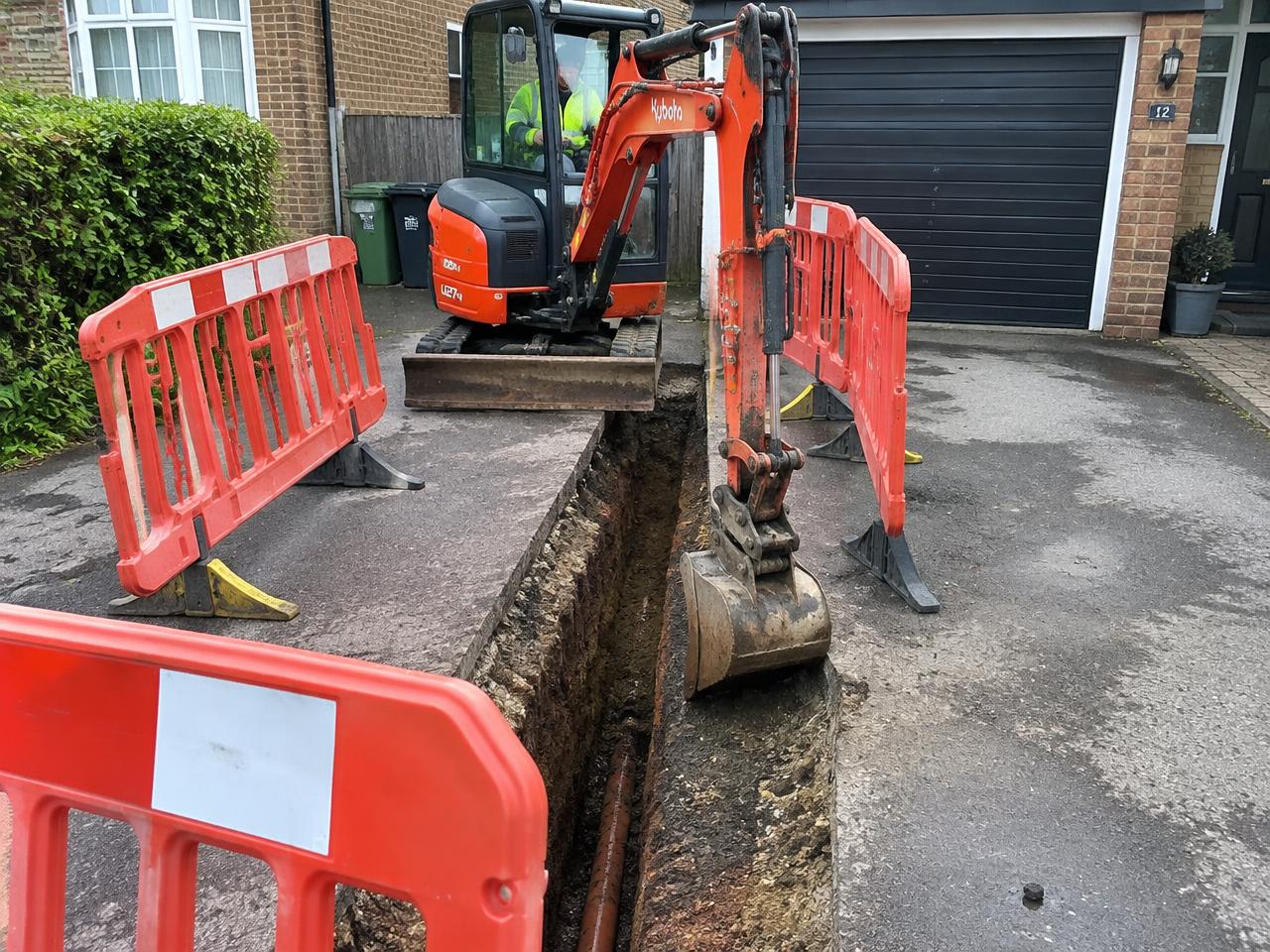
Partial and full collapses
Not every collapse looks the same. A partial collapse might be a clay pipe with a fractured crown, where a piece of the top has dropped into the bore but the base is still in place. Water still flows, but slowly, and anything solid snags on the loose section. A full collapse is where the pipe has broken down completely and soil has filled the gap, so very little gets through at all.
Older pitch fibre pipes fail in a different way. Rather than cracking, they soften and deform under the weight of the ground, going from round to oval and eventually blistering or flattening. Fractured clay and deformed pitch fibre need different decisions, which is one reason we never quote a collapse without seeing it first.
Warning signs worth taking seriously
The clearest sign is a blockage that keeps coming back in the same spot, even after a thorough clean. Others are easy to dismiss until they get worse: paving that has started to sink, a dip appearing in the lawn along the line of the drain, damp patches on a wall close to a run, or rats appearing where they never used to.
If every sink, shower and toilet in the house is draining slowly at once, the restriction is usually below ground on the main run rather than in one fitting. Gurgling from a plughole when another fitting is emptied points the same way.
Why the camera goes in first
Before anyone picks up a spade, a CCTV drain survey shows where the collapse starts and ends, how deep the pipe is, what material it is made from and whether the lengths either side are sound. That footage decides the method and stops a small hole turning into a trench twice the size it needed to be.
Sometimes the blockage has to be cleared first so the camera can get past. Where it cannot, we survey up to the collapse from both ends to pin down its position.
Relining or digging: which one applies
If the pipe still has most of its shape, a partial collapse can sometimes be rounded out and then lined from the inside. Our drain relining page explains that process. Where the pipe has broken down completely, is badly out of line or has soil packed into it, there is nothing for a liner to hold on to, and the damaged length has to be replaced.
What an excavation involves
We start by marking out the line and depth of the drain on the surface so the dig is only as wide as it needs to be. Surfaces are protected and, where paving or slabs are lifted, they are set aside for relaying. We dig down to the pipe by hand where other services may be nearby, then cut out the broken length.
The new section is modern plastic pipe joined to the old drain with flexible couplings, laid on a proper bed so it keeps its fall. Before anything is buried, the repair is tested and checked on camera. The trench is then backfilled in layers, compacted and the surface reinstated.
Working near other services
Gas, water and cables often share the ground with drains. We check for them before and during the dig and expose them carefully by hand.
Keeping the drain usable
Where possible we plan the work so the property is without its drain for as short a time as we can manage.
What decides how big the job is
The main factors are how deep the pipe sits, how long the damaged length is, what is on top of it and how easy it is to get to. A shallow run under a lawn is a very different job from a deep pipe under a block-paved drive beside a wall. Our guide to drain repair costs explains how each of these shapes a quote.
It is also worth checking who is responsible for the pipe before work is booked, as a collapse on a shared length may not be yours to fix. Our guide on who is responsible for drains sets out the usual position.
Arrange a look at your drain
Tell us what you are seeing and roughly where the drain runs. You can send the quote form or call George on 07799 153198, and we will explain the next step before any work is agreed. We work across our service area; see areas we cover.
Frequently asked questions
Can a collapsed drain be fixed without digging?
Sometimes. If the pipe has kept most of its shape, it can be reformed and lined from inside. A full collapse or a pipe packed with soil normally has to be dug out and replaced.
How do I know my drain has collapsed rather than blocked?
Repeated blockages in one place, sinking ground over the drain line and slow drainage throughout the house all point to a collapse. Only a camera survey confirms it.
Will you put my driveway back afterwards?
The area dug out is backfilled, compacted and the surface reinstated. Lifted paving is set aside and relaid where it can be reused.
Why do pitch fibre pipes collapse?
Pitch fibre was made from compressed wood fibre and tar. Over time it softens and deforms under the weight of the ground above it, rather than cracking like clay.
Is it safe to keep using the drain until the repair?
Use it as little as you can. Every flush pushes more water through a damaged length and can wash away more of the soil around it.