When relining is the right choice
Relining suits pipes that are cracked, have open or leaking joints, or have been damaged by roots, as long as the pipe still holds its basic shape. It is especially useful where the drain runs under something you would rather not disturb, such as a block-paved drive, a conservatory, a kitchen extension or a shared path.
If a pipe has fully collapsed or has a severe dip, relining alone may not be enough, and we will explain whether excavation or a combination of methods is the better option.
How the relining process works
A typical relining job follows a clear sequence.
1. Survey
A CCTV camera confirms the condition, length and diameter of the pipe and the location of any branches.
2. Clean and prepare
The pipe is jetted clean and any roots or protruding debris are cut back so the liner sits tight.
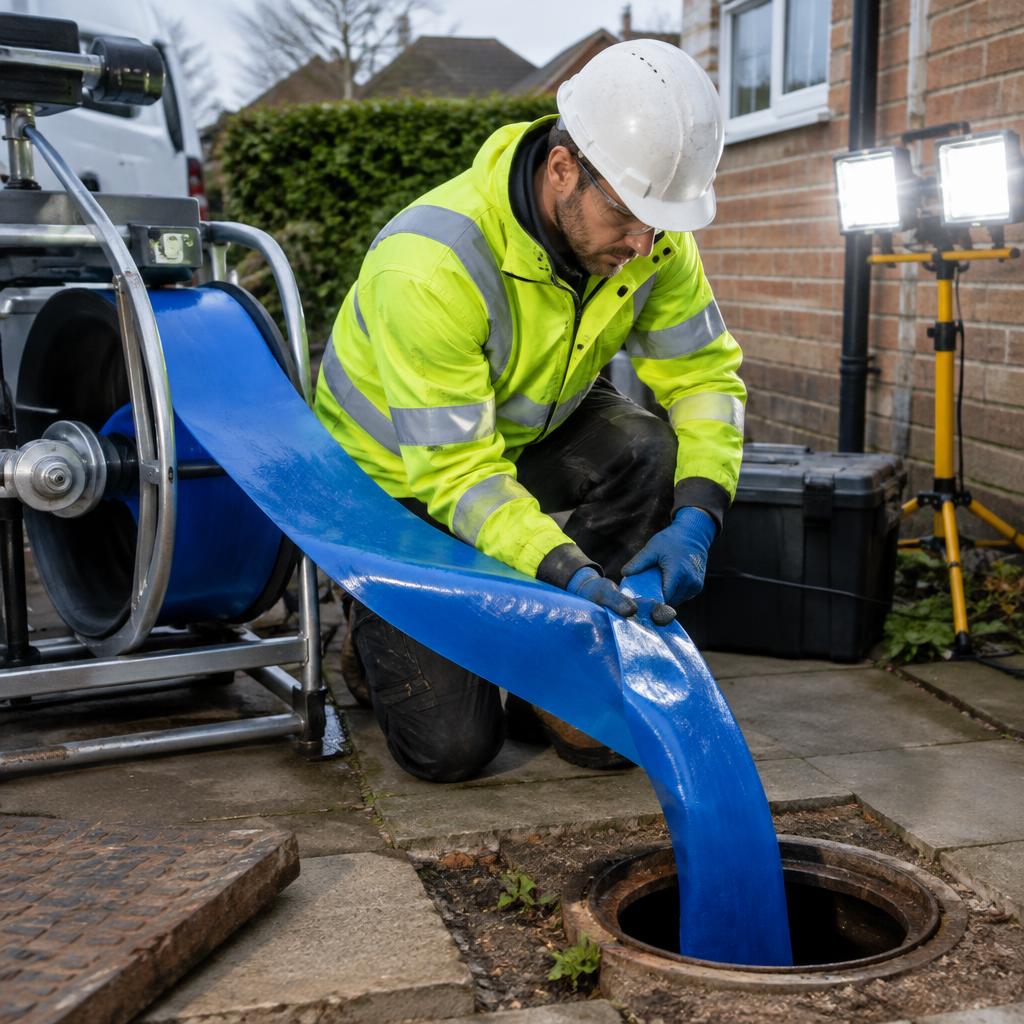
3. Install the liner
The resin-impregnated liner is inserted and inflated so it presses against the pipe wall.
4. Cure and check
Once cured, any branch connections are reopened and a final camera check confirms the result.
Benefits of relining
Because there is no trench, there is far less mess, no skips full of soil and no need to relay paving or turf. The new lining has no joints for roots to get into and a smooth bore that helps waste flow freely. Work is usually completed far faster than an equivalent excavation.
Relining also avoids disturbing services that may run near the drain, such as gas, water and cables, which reduces risk on tight urban plots.
Localised patches and full-length liners
Not every damaged drain needs relining end to end. Where the fault is limited to a single crack or joint, a short patch liner can be used to fix that spot. Where damage is spread along the run, a full-length liner is normally the better value. We will recommend whichever genuinely suits the pipe.
Relining after root damage
Roots are one of the most common reasons a drain ends up being relined. They find their way in through small gaps at the joints, then thicken until they crack the pipe and catch everything that passes. Cutting them out restores flow for a while, but the joints they came through are still open, and the roots grow back.
Once the roots have been removed and the pipe cleaned, a continuous liner seals every joint along the run at once, so there is no gap left for new growth to exploit. Where only one or two joints are affected, a no-dig patch repair may be enough. Our guide to tree roots in drain pipes explains the warning signs, and drain repair costs covers what affects the price of a liner.
Before lining a root-damaged pipe, we check the footage carefully for any length where the roots have pushed the pipe out of shape. A liner needs a reasonably round pipe to sit against, so a badly distorted section may need replacing first, with the rest of the run lined afterwards. Doing it in that order gives a sealed drain from end to end and avoids leaving a weak spot.
Once the liner has cured, the camera goes back through so you can see the sealed joints for yourself, with no roots left in the bore.
Ask about relining your drain
Call 07799 153198 or send the form with your postcode. If you already know where the damaged section is, tell us what sits above it, such as a driveway or extension, so we can plan the job.
Frequently asked questions
Does relining reduce the size of the pipe?
Very slightly, by the thickness of the liner, but the smooth jointless surface usually improves flow.
Can relining go round bends?
Many liners can handle gentle bends. Tight bends are assessed during the survey.
Is relining a permanent repair?
A correctly installed liner is designed as a long-term structural repair rather than a temporary fix.
Will roots grow back through a liner?
A liner has no joints along its length, so roots have nowhere to get in once it is installed.
Can a drain with bends be relined?
Gentle bends usually can. Very tight bends may need a different approach, which the survey will show.
What happens to branch connections when a pipe is relined?
Connections are reopened from inside after the liner has cured, so the pipes joining the run still drain into it.